In-vitro technical platform for other high valuable readouts
In vitro technical platform for single cell analysis and biomarker quantification.
To complement in vivo readouts, ERBC provides a full range of in vitro services on-site: Flow Cytometry, Luminex assays, RT-qPCR, microbiological assays (CFU, PFU) as well as cell culture and bacterial/viral amplification.
If you would like a specific assay that is not listed above, please contact us to discuss possibilities and feasibility for your custom request.
Flow cytometry
ERBC uses BD FACSLyricTM Flow Cytometry System (BD Biosciences), with 12 parameters and 10 colors available: 4 on blue laser / 3 on red laser / 3 on violet laser, with analysis performed on BD FACSuiteTM software (BD Biosciences). The flow cytometer is coupled to a Class I biosafety hood for sorting samples at BSL-2 levels.
Biomarker quantification
To quantify cytokines and proteins of interest, ERBC is equipped with the latest MAGPIX® System (Luminex Corporation) to perform Luminex assays.
Microbiology, CFU, PFU assays
Our microbiology laboratory is specialized in amplifying viral and bacterial strains from BSL-2 to BSL-3 levels, both for in vitro and in vivo applications.
Viral and bacterial titers are determined via performing PFU or CFU assays, with our high-throughput Scan®-500 (Intersciences) counter for automated CFU count.
For bacteria, we have the ability to count either non-adherent (planktonic) or adherent bacteria to evaluate biofilm development (such as biofilm development on catheters).
RT-qPCR
ERBC’s genomic platform is specialized in the extraction of RNA and DNA from various samples (bacteria, viruses, cells, tissues) using fully automated nucleic acid extraction (QIAcube® QIAGEN).
With our LightCycler® 480 System (Roche Life Science), we provide qualitative and quantitative analysis of target gene expression and viral/bacterial load (RNA/DNA) in tissues of interest.
Cell culture
ERBC has a dedicated cell culture platform for amplifying tumor cell lines for animal models. This platform is also used for custom cell-based assays (cell viability, absorbance/fluorescence readings).
In vivo technical platform and imaging facilities
ERBC is strong of 14 years of experience in providing high-resolution preclinical imaging services, with whole animal anatomical (CT, micro-CT) and functional imaging (bioluminescence and fluorescence tomography).
We have the capacity to combine several imaging techniques to monitor the pathological process (tumor/infection kinetics), compound efficacy as well as compound biodistribution and colocalization with the pathology, in the same animals over time.
Animal housing and facilities
ERBC displays a total area of 400m² accredited animal facilities, with segregated BSL-2 and BSL-3 facilities. We have the capacity to house a wide range of small species:
- Rodents: mice, rats, hamsters
- Guinea pigs
- Rabbits (lagomorphs)
- Ferrets
- Poultries
- Marmosets
Rodents are hosted in irradiated single-use cages on ventilated racks, maintaining SOPF or SPF health status. Other species are housed in parks, according to each species space and social housing needs.
The facility includes a Surgical Platform
Our fully-equipped surgery facility displays an induction and recovery room to perform surgeries in optimal aseptic conditions, with a dedicated anesthesiologist and surgeon working together. Our technical staff is fully trained to perform complex microsurgeries and technical procedures, with regular training for preparing custom demands from our clients.
We also have experience with working with large species. In this case, large animals are housed by our dedicated partners and transported to ERBC for on-site imaging analysis.
The modern design of ERBC’s facilities, work process, controlled environment and health status monitoring system ensures consistency while maintaining high standards of animal welfare.
Anatomical imaging
CT and µ-CT
X-ray computed tomography (CT) gives 3-dimensional images of naturally dense tissues or soft tissues following injection of a contrast agent.
Such acquisitions provide 3D information on anatomical characteristics (length, surface, volume, curvature, thickness, density…) and avoid the bias of analyzing only 2D single slices.
At ERBC, we operate 3 types of CT scans on-site.
- In vivo CT scan for large species: 3D acquisitions on live animals from rabbits to 200 kg-pigs (CT scan ring diameter of 70 cm), with minimum 180 µm resolution and minimum 310 µm slice thickness.
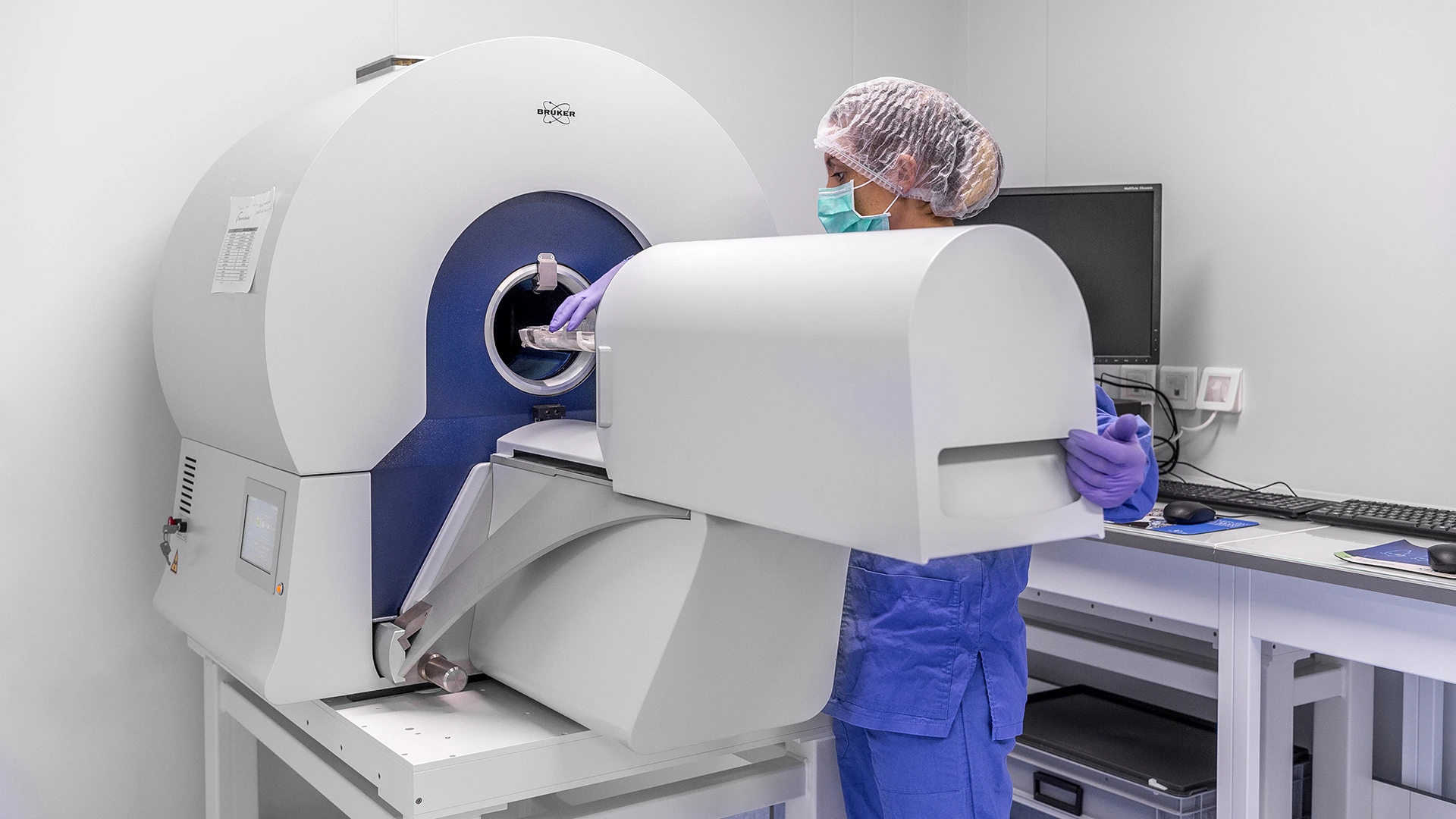
- In vivo µ-CT scan for small species: 3D acquisitions on live rodents from mice to guinea pigs (µ-CT scan ring diameter of 80 mm), with 50 µm resolution, 50 µm slice thickness and acquisition times from 2 to 10 min.
- Ex vivo µ-CT scan for isolated tissues: with 30 to 6 µm resolution.
Functional imaging
Bioluminescence and Fluorescence Tomography
Optical molecular imaging follows biochemical processes in vivo, in whole live animals.
At ERBC, we operate 3 optical imaging systems (IVIS®-Spectrum, PerkinElmer) for 2D and 3D bioluminescence and fluorescence in vivo imaging: 1 system in our BSL-2 facilities; 1 system in our BSL-3 facilities; and 1 system combining 2D and 3D bioluminescence/fluorescence imaging with X-ray radiography.
- Bioluminescence imaging enables to follow compound efficacy in Cancer or Infectious diseases models, by using cancer cell lines or infectious strains (viruses, bacteria) that express luciferase. This gives the opportunity to study whether a compound reduces tumor burden or bacterial/viral load in a longitudinal manner and if it can even cure/reverse the pathological process.
- Fluorescence imaging can be used to follow compound biodistribution in whole live animals. This imaging technique is sufficiently sensitive on small species (small absorption and diffusion rates) and most labeling protocols remain easy to handle. Image resolution ranges from 20µm to 2mm.
Surgical Platform
Our fully-equipped surgery facility displays an induction and recovery room to perform surgeries in optimal aseptic conditions, with a dedicated anesthesiologist and surgeon working together. Our technical staff is fully trained to perform complex microsurgeries and technical procedures, with regular training for preparing custom demands from our clients.